

German-Ethiopian
Textile Business Partnership

Scaling Up: Afar as the Next Growth Level
In addition to the established pilot region of Arba Minch, the Afar region is currently being developed for organic farming. In this region the land areas, including those of smallholder farmers, are significantly larger. This opens the possibility of rapidly expanding production and in the medium term, providing industrially relevant quantities. Mesele Mekuria, the local project manager, emphasizes: “The conditions in Afar are exceptionally good – we see real potential here for volume growth with very good fiber staple length.”
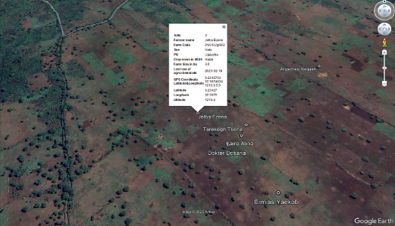
Fig 1. Shows land area and farmer traceability via Google Earth
Proven Quality
The initial test results regarding the fiber quality of samples from Arba Minch are very positive. Laboratory analyses – conducted both in Ethiopia and in Germany on behalf of initial interested parties – show excellent spinnability. One member company has reached a clear conclusion: “The Ethiopian cotton is very good, absolutely “Convincing.” It has shown a low Short Fiber Index (less waste), an ideal Micronaire value, and a fiber length close to long-staple quality. This means the cotton is not only certified organic, but also Suitable for more demanding applications. “The next step is yarn and fabric samples – then we’ll see how quickly concrete business relationships develop,” says Stephan Rehlen.
Cooperation with the Ethiopian Ministry of Agriculture (MoA) is a key success factor. Through development agents, the ministry provides ongoing support to local farmers in their conversion to organic farming. At the same time, it also comprises the Ethiopian textile and Garment manufacturing association (ETGAMA) which plays a crucial role in the integration, processing and marketing of organic cotton into existing industrial structures.
The project demonstrates how a sustainable textile supply chain can be established, from the field to industrial processing. The combination of a growing number of farmers, increasing acreage, convincing fiber quality, and initial market signals forms a solid foundation. “The crucial factor now will be to further scale up production and successfully integrate the farmers into the market,” says long-term expert Stephan Rehlen. “As soon as the investment in organic farming becomes economically viable, it will pay for itself.”